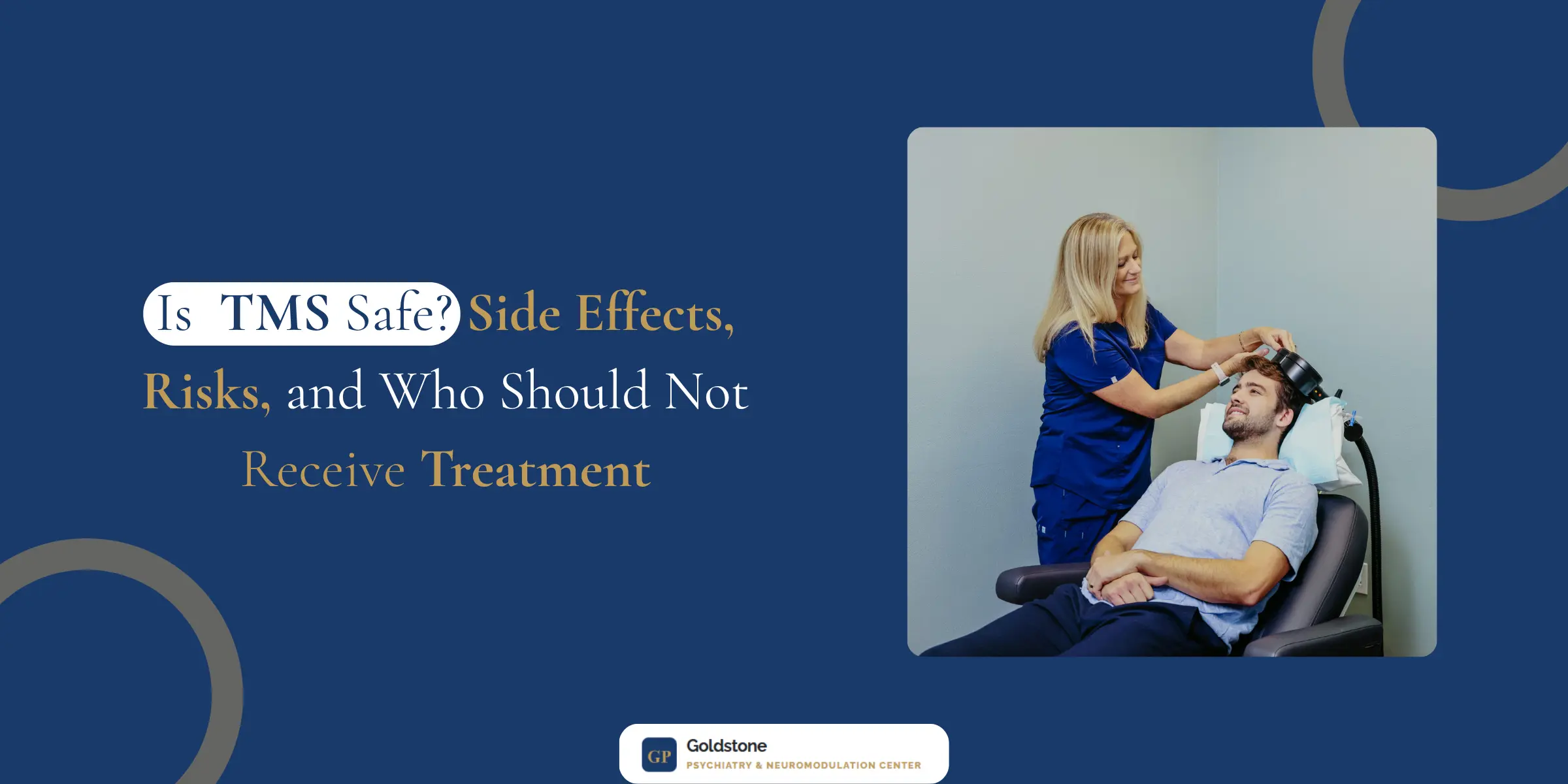
An honest, complete look at the safety of TMS, including the things most articles skate past.
When people consider a treatment that works on the brain, the first question is almost never about how well it works.
It’s about safety.
Is this going to hurt me? Could something go wrong? Are there effects I’m not being told about? Is it safe to do this to my brain?
These are exactly the right questions to ask, and they deserve a complete answer rather than a reassuring one. A treatment is only worth considering if you understand its actual risks, not a sanitized version of them. So this is an honest account of TMS safety: what’s common, what’s rare, what’s serious, and who genuinely should not receive it.
The short version, which the rest of this article will support, is that TMS has a strong safety record and is well tolerated by most people. But “generally safe” is not the same as “safe for everyone,” and the details matter.
What makes TMS different from the start
Part of understanding TMS safety is understanding what it isn’t.
TMS is non-invasive. Nothing is implanted, injected, or introduced into your body. There’s no anesthesia and no sedation. It doesn’t circulate a drug through your system, which means it avoids the entire category of side effects that come from a medication traveling everywhere in the body, the weight changes, the sexual side effects, the effects on the liver or kidneys, the interactions with other drugs.
TMS works locally, using magnetic pulses to stimulate a specific region of the brain, and the person stays fully awake and alert throughout. That local, drug-free, non-invasive design is the foundation of its safety profile, and it’s why the risks are relatively contained compared with many other treatments in medicine.
It has been FDA-cleared for depression since 2008, with more than a decade and a half of real-world use and a substantial body of research behind it. This is not a new or experimental treatment.
The common side effects
Most side effects of TMS are mild, localized to the treatment area, and temporary. Here’s what people actually experience.
Scalp discomfort during treatment. The most common effect. During the pulses, many people feel a tapping, knocking, or slight pulling sensation at the treatment site, and the scalp in that area can feel sensitive or tender, especially in the first several sessions. For most people this is mild and fades as the scalp acclimates over the first week or two.
Headache. Also common, particularly early in the course. It’s typically the ordinary kind of headache that responds to over-the-counter pain relief, and like the scalp sensitivity, it tends to diminish as treatment continues and the body adjusts.
Facial muscle twitching. During the pulses, the muscles near the treatment site, in the forehead, around the eye, or in the jaw, can contract slightly, causing a twitching or tugging sensation. It happens only during the actual stimulation and stops when the pulse stops. It’s harmless, if a little strange to feel.
Lightheadedness. Some people feel briefly lightheaded during or right after a session. It passes quickly.
Mild fatigue. A minority of people notice some tiredness, particularly in the early part of the course.
That’s essentially the complete list of what most people experience, and for a serious medical treatment, it’s a notably gentle one. These effects are the reason TMS is often described as well tolerated: they’re real, but they’re minor, and they generally fade rather than accumulate. Importantly, TMS does not cause the effects people most fear from brain-based or psychiatric treatment: it does not impair memory, does not affect cognition, does not sedate you, and does not change your personality.
The serious risk: seizure
Now the part that a genuinely honest article has to address directly, because it’s the one that matters most.
The most significant risk of TMS is a seizure. It is also rare.
Because TMS stimulates brain activity, there is a small risk that it could trigger a seizure during treatment. In people without specific risk factors, this risk is very low, estimated in the range of roughly one in tens of thousands of sessions. To put that in perspective, the overwhelming majority of people who undergo a full course of TMS will never experience one, and when seizures do occur in the TMS setting, they happen during the session, under supervision, and are self-limited, meaning they resolve on their own without lasting harm.
Still, it’s a real risk, and it’s the reason the screening process before TMS is thorough rather than a formality. The screening is specifically designed to identify the factors that raise seizure risk so that people who would be at meaningfully higher risk can be identified in advance. This is also why certain conditions and circumstances lead a clinician to recommend against TMS, or to proceed only with particular caution, which we’ll come to shortly.
There is a related point worth naming honestly. Some medications, certain substances, alcohol withdrawal, sleep deprivation, and other conditions can lower the seizure threshold, meaning they make a seizure somewhat more likely. A careful evaluation reviews all of this, which is part of why an accurate, complete history matters so much before starting.
Hearing, and why you’ll wear earplugs
The TMS machine produces a loud clicking sound with each pulse. Repeated exposure to that sound, without protection, could potentially affect hearing.
This is why earplugs are used at every session. With appropriate hearing protection, this risk is effectively managed, and it’s a simple, standard part of every treatment. It’s worth mentioning only because it’s a real consideration that the earplugs exist to address, not an afterthought.
The question of long-term safety
People reasonably wonder whether doing this repeatedly, day after day for weeks, could have effects that show up later.
The reassuring answer, supported by the length of time TMS has been in use and the research conducted over that period, is that TMS has not been associated with long-term or delayed harmful effects on the brain. It does not cause the cumulative damage people sometimes imagine when they picture repeated brain stimulation. The effects people experience are the short-term ones described above, and they resolve. There is no evidence that a standard course of TMS produces lasting adverse effects on cognition, memory, or brain health.
For people who respond and later relapse, TMS can generally be repeated, which itself reflects its favorable long-term safety profile.
Who should not receive TMS, or should proceed with caution
This is where “generally safe” becomes specific, and where an honest article earns its trust. TMS is not appropriate for everyone. Several situations call for either avoiding it or approaching it with particular care.
Metal or implanted devices near the head. This is the most important absolute consideration. Because TMS uses a strong magnetic field, people with non-removable metallic or magnetic-sensitive objects in or near the head cannot safely undergo standard TMS. This includes things like aneurysm clips or coils, certain stents in the neck or head, implanted stimulators or electrodes in or near the head, cochlear implants, and metallic fragments in the eye or skull. Standard dental fillings, braces, and most implants below the head are generally not a concern, but this is exactly the kind of thing the screening exists to sort out precisely. This is not an area for guessing; it’s an area for a careful, specific review.
A history of seizures or epilepsy. Because the primary serious risk is seizure, a personal history of seizures or epilepsy, or a condition that predisposes to them, requires careful evaluation. It doesn’t always mean TMS is off the table, but it changes the calculation significantly and calls for specialized judgment.
Certain neurological conditions. Brain injuries, strokes, brain tumors, and other neurological conditions require individual assessment, because they can affect both the safety and the appropriateness of treatment.
Factors that lower the seizure threshold. Active heavy alcohol use, withdrawal states, significant sleep deprivation, and certain medications that lower the seizure threshold are all things that a clinician weighs carefully, and sometimes addresses first, before proceeding.
Pregnancy. TMS is often considered a comparatively appealing option during pregnancy precisely because it avoids exposing a developing baby to medication. That said, its use in pregnancy should always be an individualized decision made carefully with your physician, weighing your specific situation.
A note on bipolar disorder. This isn’t a safety exclusion so much as a reason the diagnosis must be right. As with antidepressant treatment, stimulating mood circuits in someone with an unrecognized bipolar pattern requires care and monitoring, which is another reason a thorough evaluation, not just a safety checklist, precedes treatment.
The common thread across all of these is that they’re identified through screening. None of them is a reason to fear TMS in general; they’re reasons the evaluation before TMS needs to be thorough and physician-led rather than a quick intake. A good program treats screening as a core part of the treatment, not a box to check.
Why the evaluation is the real safety measure
If there’s one thing to take from all of this, it’s that the safety of TMS depends heavily on who is delivering it and how carefully they assess you first.
TMS in appropriate candidates, screened properly and delivered by a competent team, has an excellent safety record. TMS delivered without adequate screening is where avoidable risk lives. The magnetic coil is the same everywhere; the difference between safe treatment and unnecessary risk is the quality of the evaluation that comes before it.
That evaluation does two things at once. It confirms that TMS is safe for you specifically, by identifying the factors above. And it confirms that TMS is the right treatment for what’s actually going on, by making sure the diagnosis is correct and nothing important has been missed. Both of those protect you, which is why TMS should always begin with a physician who takes the time to do it properly.
The takeaway
Is TMS safe? For most people who are appropriate candidates, yes, with a strong safety record built over more than fifteen years of use.
The common side effects, scalp discomfort, headache, facial twitching during the pulses, are mild and tend to fade. It doesn’t affect memory, cognition, or personality, and it isn’t associated with long-term harm to the brain. The one serious risk, seizure, is rare, occurs under supervision, resolves on its own, and is specifically what the screening process is designed to guard against.
The honest qualifier is that TMS is not safe for everyone. People with certain implanted devices or metal near the head, a history of seizures, specific neurological conditions, or other risk factors need careful individual assessment, and some should not receive standard TMS at all. That’s not a weakness of the treatment; it’s the reason a thorough, physician-led evaluation matters so much.
Understood properly, TMS is one of the better-tolerated serious treatments in psychiatry. And the single most important safety decision you can make is choosing to be evaluated by a clinician who will take that screening as seriously as the treatment itself.
Goldstone Psychiatry & Neuromodulation Center provides physician-led evaluation and TMS therapy, with thorough screening as a core part of every treatment plan. Telepsychiatry is available throughout Texas for the psychiatric care that surrounds treatment.
