The honest, sensory answer to the question people are actually asking when they consider TMS.
There’s a question people ask about TMS that the clinical descriptions never quite answer.
They can find out that it’s FDA-cleared, that it’s non-invasive, that it stimulates the brain regions involved in mood. They can read that it takes about six weeks and that most people tolerate it well. All of that is true, and all of it is strangely unsatisfying, because it doesn’t answer the thing they actually want to know.
What does it feel like?
Will it hurt? What am I going to feel on my head? Will I feel strange during it? Will I feel different afterward, and if so, when? What do I actually do for those minutes in the chair?
These are the right questions, and they deserve a real answer rather than a brochure. So here is an honest, sensory walk through TMS, from the first visit to the end of a course, describing what it actually feels like at each stage.
Before treatment: the first visit and mapping
Your first TMS session is different from all the ones that follow, and it’s longer. This is the mapping visit, and it’s worth understanding because it’s where a lot of the first-time nervousness lives.
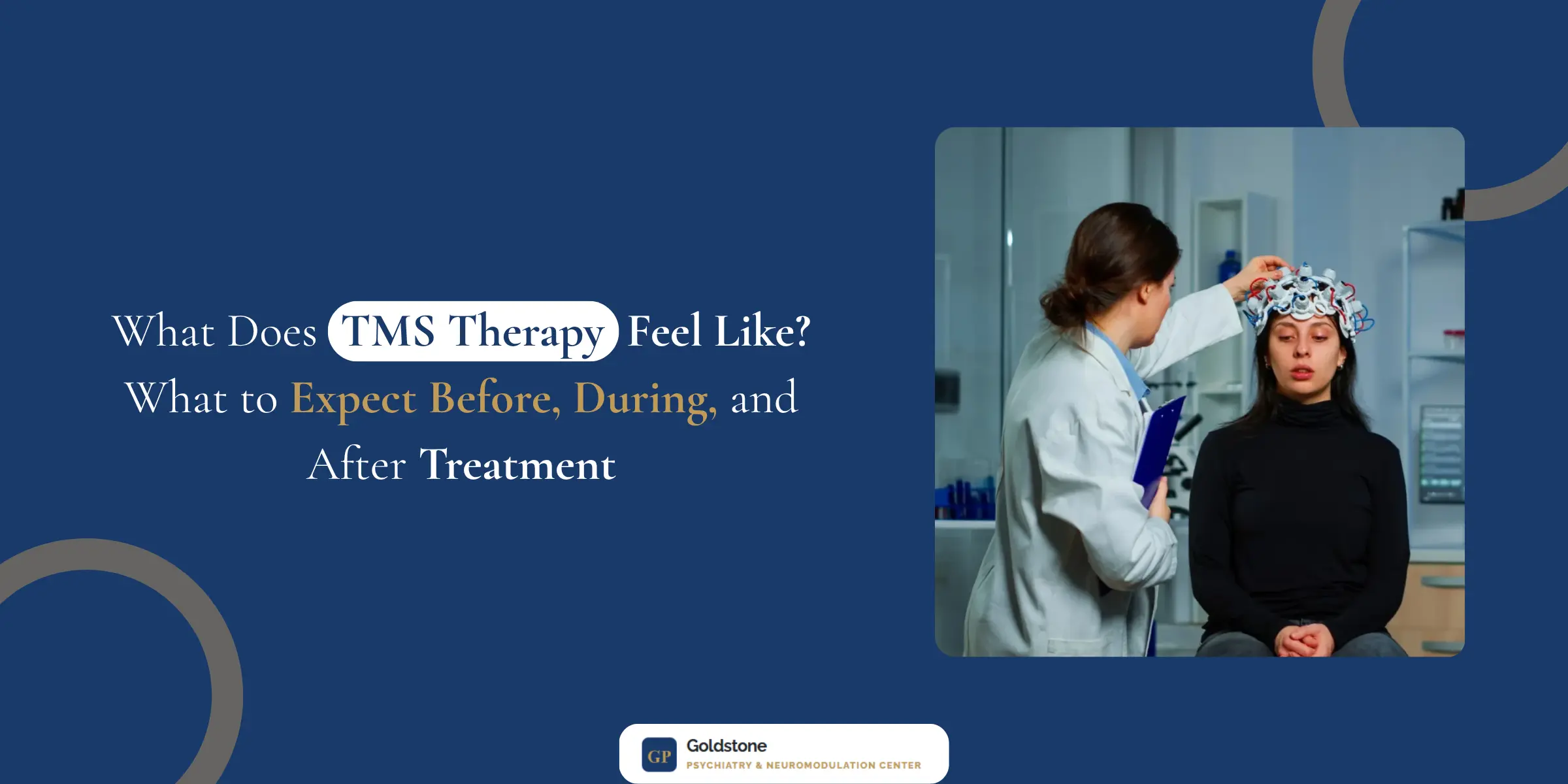
You’ll sit in a comfortable chair, something like a reclining exam chair. You stay fully clothed. Nothing is injected, nothing is attached to your body, and you remain completely awake and aware the entire time. There’s no anesthesia and no sedation of any kind.
The clinician positions the treatment coil against your head and delivers a series of brief pulses while doing two things. First, they determine your motor threshold, which is the amount of stimulation your individual brain needs. They do this by finding the spot that makes your thumb or fingers twitch slightly, a small, involuntary movement that tells them how responsive your brain is to the magnetic field. It’s a little strange to watch your own hand move on its own, but it doesn’t hurt, and it’s genuinely useful, because it’s how the treatment gets calibrated to you specifically rather than to an average.
Second, they locate the precise treatment target on your scalp, the spot over the brain region involved in mood regulation, and measure it out so it can be found again consistently at every session.
This mapping is personalized to your anatomy, and it’s part of why a well-run TMS program isn’t just a machine in a room. The setup determines the results.
During treatment: what you actually feel
Here’s the part everyone wants described honestly.
When the treatment begins, the coil rests lightly against your head at the mapped location. When the pulses fire, you feel a tapping sensation on your scalp, right at that spot. People describe it in different ways: a light knocking, a woodpecker-like tapping, a rhythmic drumming against one area of the head. It comes in short bursts, a few seconds of tapping followed by a brief pause, then another burst, in a steady, predictable rhythm throughout the session.
Is it painful? For most people, not really, though it’s fair to call it odd at first, and some people find it mildly uncomfortable in the early sessions, particularly on the first few days. The scalp in that area can feel sensitive. There’s often a tapping or slight pulling sensation on the surface, and sometimes a feeling in the muscles of the forehead or jaw, because the pulses can cause small contractions in the muscles near the treatment site. Some people notice a slight twitch at the corner of the eye or in the cheek during the pulses.
The important thing about this discomfort is that it almost always fades. The scalp tends to acclimate over the first week or so, and what felt strange and sensitive on day one usually becomes unremarkable, something you barely notice, by the second week. If it’s genuinely uncomfortable, the settings can be adjusted, and a good clinician would rather ease you into it than have you dread coming back.
There’s also a sound. The machine makes a clicking noise with each pulse, which is why you’ll be given earplugs to wear. The clicking is loud enough to warrant them but not alarming once you know it’s coming.
And that’s essentially it. You’re awake. You can see, hear, and talk. You’re not sedated or altered. You’re simply sitting in a chair feeling a rhythmic tapping on one spot of your head while a machine clicks, for the length of the session.
What you do during the session
One of the pleasant surprises of TMS is how ordinary the time actually is.
Standard sessions run somewhere in the range of twenty minutes or so, though this varies by the specific protocol and device, and some newer approaches are considerably shorter. Throughout, you’re just sitting there, so people fill the time the way they’d fill any twenty minutes of sitting still.
Many people listen to music or a podcast. Some watch something. Some talk with the technician. Some close their eyes and rest, or let their mind wander, or use it as a rare pocket of quiet in the day. You do need to keep your head reasonably still so the coil stays on target, so it’s not the time for anything that requires you to move around, but beyond that, it’s yours.
A lot of patients come to find the sessions almost meditative once the initial strangeness wears off. Twenty minutes, same time each day, nothing required of you but to sit. In a busy life, that can become a small island rather than a chore.
After each session: driving home and getting on with your day
This is one of the genuine advantages of TMS, and it’s worth stating plainly.
When the session ends, you’re done. You stand up and walk out. There’s no recovery period, no grogginess, no waiting around. Because there’s no anesthesia or sedation, you can drive yourself home, go straight back to work, pick up your kids, run errands, exercise, whatever your day holds. Nothing about the treatment impairs you.
The most common after-effect, and it’s not universal, is a mild headache, particularly in the first week. It’s usually the ordinary kind that responds to over-the-counter pain relief, and like the scalp sensitivity, it tends to diminish as your body adjusts to the treatment. Some people notice mild fatigue early on. Most people notice nothing at all and simply resume their day.
You will not feel “out of it.” You will not need someone to accompany you. You’ll just leave.
Over the weeks: how the change actually arrives
This is the part that surprises people most, and it’s important to set expectations honestly, because the way TMS works is different from what many people imagine.
TMS is not a switch. You don’t have a session and walk out feeling better. The change, when it comes, tends to arrive gradually and often quietly, over the course of the treatment series, as the repeated stimulation does its work on the brain’s circuits over time.
Most people don’t notice much in the first week or two. That’s normal and expected, and it’s worth knowing in advance, because the early weeks can feel discouraging if you’re waiting for an immediate lift. Somewhere in the middle-to-later weeks of the course is when improvement more commonly begins to show.
And here’s the interesting part: the change is often noticed by other people before the patient notices it themselves. A partner mentions that you seem lighter. You realize you laughed at something and meant it. You get out of bed without the usual weight. You catch yourself looking forward to something. The dark, flat quality that had settled over everything starts, subtly, to lift.
Some people describe it as color slowly returning. Some describe it as the volume of the depression gradually turning down. Rarely is it a dramatic before-and-after moment. More often it’s a slow, cumulative thing that you recognize in retrospect, realizing one day that you’ve felt more like yourself for a while now.
Not everyone responds, and an honest account has to say so. But for those who do, this gradual, gathering improvement is the actual texture of how TMS works.
The rhythm of a full course
Putting the whole arc together, here’s what the experience is like as a stretch of your life.
A standard course involves coming in five days a week for roughly six weeks, about thirty to thirty-six sessions in total. That daily rhythm is a real commitment, and it’s worth being honest that the logistics, the daily drive, the scheduling, are the hardest part of TMS for most people, more than anything about the treatment itself.
But the sessions themselves are brief and undramatic, and the daily routine has a way of becoming just that, a routine. Many people describe settling into it: same time each day, a familiar chair, a technician they come to know, twenty quiet minutes, and back to life. Toward the end of the course, as improvement builds, the visits often start to feel less like an obligation and more like something that’s working.
There are also accelerated protocols now that compress this into a much shorter window for people who can’t manage six weeks of daily visits, which changes the logistics considerably. Whether that fits your situation is part of what an evaluation determines.
What TMS does not feel like
A few reassurances, because the fears people bring in are often worse than the reality.
It doesn’t feel like electroconvulsive therapy. TMS and ECT are entirely different treatments. TMS involves no anesthesia, no seizure, no memory effects, and no recovery. The dramatic images some people associate with brain-based treatment have nothing to do with what happens in a TMS chair.
It doesn’t produce an altered state. You’re not sedated, high, dissociated, or changed in the moment. You’re just sitting there feeling a tapping sensation, fully yourself.
It doesn’t hurt in the way people brace for. The discomfort, when it exists, is mild scalp sensation and the occasional headache, and it fades. It is not painful in any serious sense, and it’s nothing like what the word “stimulation” might lead someone to imagine.
And it doesn’t require you to rearrange your identity around being a patient. You come in, you sit for twenty minutes, you leave, you live your life. For a treatment that works on the brain, it asks remarkably little of you.
The takeaway
The honest answer to “what does TMS feel like” is that it feels like far less than people expect.
A tapping sensation on one spot of your head. A clicking machine and a pair of earplugs. Twenty or so minutes in a comfortable chair, awake and yourself, listening to music or resting. A drive home afterward with nothing to recover from. Some scalp sensitivity and maybe a mild headache in the first week that settles as your body adjusts. And then, gradually, over the weeks, for many people, the slow return of something that had been missing.
It is one of the least dramatic serious medical treatments you can undergo, which is exactly what makes it such a good option for people who need real help but can’t or don’t want to take on the burdens that other treatments carry.
If depression hasn’t responded to what you’ve already tried, and the mystery of what TMS is actually like has been part of what’s held you back, the reality is gentler than the question makes it sound.
Goldstone Psychiatry & Neuromodulation Center offers TMS therapy and a full range of advanced treatments for depression, delivered in a calm, physician-led setting. Telepsychiatry is available throughout Texas for the psychiatric care that surrounds treatment.
