If antidepressants haven’t worked, or haven’t worked without a cost you can live with, there’s a treatment worth understanding.
Most people don’t arrive at TMS quickly.
They arrive after a long road. A first antidepressant that helped a little, or not at all. A second one that brought side effects they couldn’t tolerate. Maybe a third, or a fourth, each started with a flicker of hope that faded over the weeks that followed. Somewhere along that road, the question changes. It stops being which medication will fix this and becomes something quieter and harder: is anything going to work?
If you’ve reached that question, it’s worth knowing that the honest answer is usually yes, and that the next step often isn’t another medication.
Transcranial magnetic stimulation, or TMS, is a treatment for depression that works in a fundamentally different way from the pills you’ve already tried. It isn’t a last resort reserved for hopeless cases, and it isn’t experimental. It’s an established, FDA-cleared treatment that has been available for depression since 2008, and it exists specifically for people whose depression hasn’t responded to standard approaches.
The question is whether you’re a candidate. Here’s how to think about that.
What TMS actually is, briefly
Before the signs, a quick grounding in what we’re talking about.
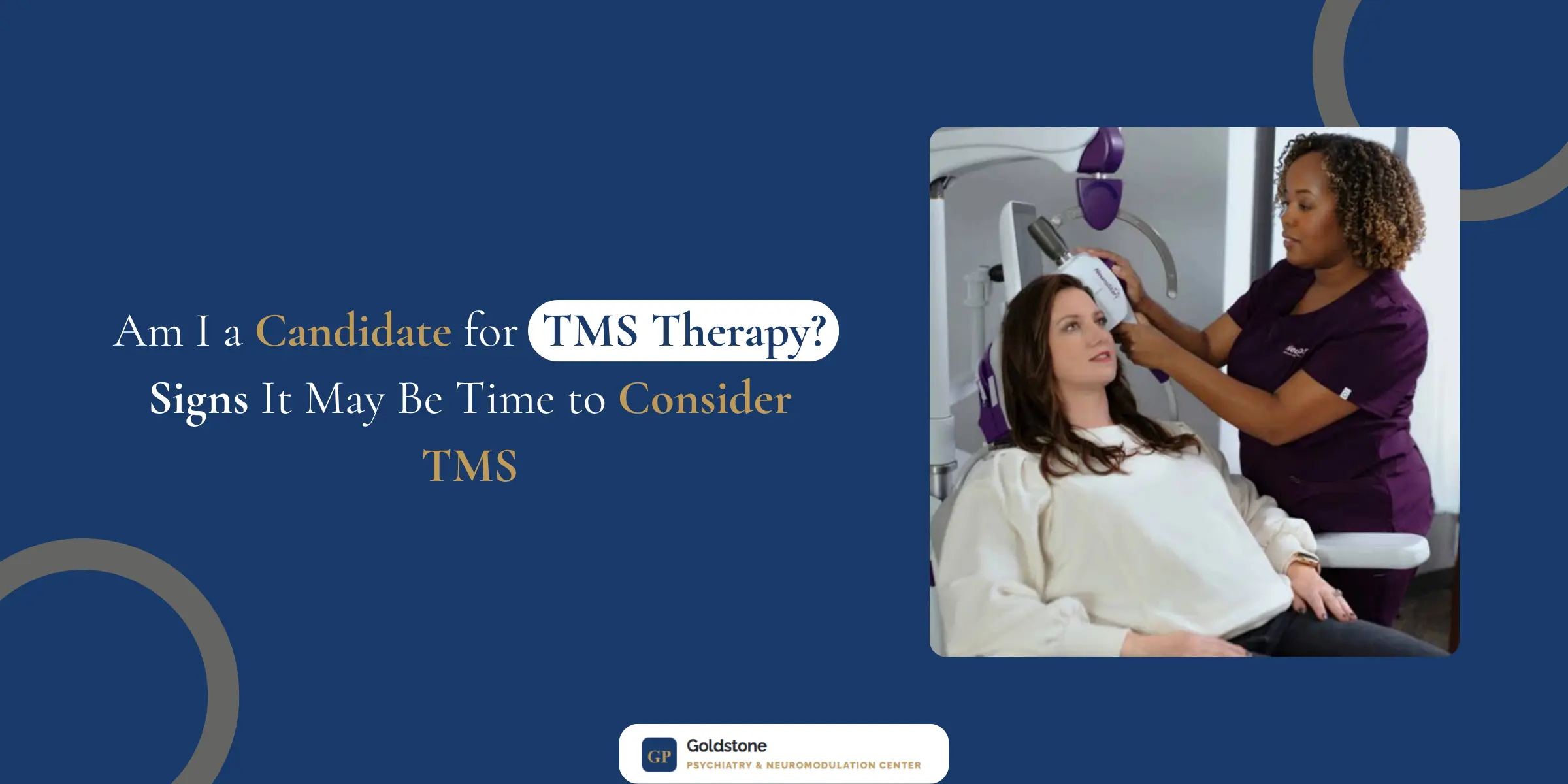
TMS uses focused magnetic pulses, delivered through a coil placed gently against the scalp, to stimulate the areas of the brain involved in mood regulation. It’s not a medication. Nothing enters your bloodstream. There’s no anesthesia, no sedation, and no recovery time. You sit in a chair, awake and alert, for a treatment session, and then you drive yourself home and go on with your day.
Because it works on brain circuits directly rather than circulating through your entire body, it doesn’t cause the side effects people most dread from antidepressants: the weight gain, the sexual dysfunction, the emotional flatness, the sedation.
That different mechanism is the whole point. If medications that work through your body’s chemistry haven’t helped, a treatment that works through the brain’s electrical activity may reach something they couldn’t.
The clearest sign: your depression hasn’t responded to medication
This is the central one, and it has a name.
When depression hasn’t improved adequately after trying two or more antidepressants, each at a reasonable dose for a reasonable length of time, clinicians call it treatment-resistant depression. It’s common. Roughly a third of people with depression fall into this category, which means millions of people have had exactly the experience of trying medication after medication without finding relief.
TMS was designed for this situation. It’s FDA-cleared specifically for adults with major depressive disorder who haven’t achieved satisfactory improvement from antidepressant medication. If you’ve given two or more antidepressants a genuine try and you’re still struggling, that alone makes you worth evaluating for TMS.
A word about what “a genuine try” means, because it matters. A medication trial only really counts if the dose reached the therapeutic range and you stayed on it long enough for it to work, generally six to eight weeks. A lot of people conclude that medications have failed them when what actually happened is a series of trials that were too short, too low in dose, or stopped early because of side effects. Part of a good TMS evaluation is sorting out whether your prior trials were adequate, because that changes the picture.
You can’t tolerate the side effects of antidepressants
Some people aren’t treatment-resistant in the usual sense. The medications work. They just come at a cost the person can’t live with.
Weight gain that won’t stop. Sexual side effects that strain a relationship. A flatness that takes the color out of everything, so that the depression lifts but nothing feels good either. Sedation that makes daily life a fog. Nausea, or headaches, or tremor.
For these patients, the problem isn’t that nothing helps. It’s that everything that helps also hurts. TMS is worth serious consideration here, because it sidesteps the entire category of systemic side effects. It’s one of the more common reasons people choose TMS even when medication technically “works” for them.
You’ve had partial relief, but never full recovery
This one is underappreciated, and a lot of people don’t realize it applies to them.
Maybe your medication took the edge off. The worst of the darkness lifted. You’re functioning. But the motivation never fully came back, or the joy is still muted, or you feel like you’re operating at seventy percent of yourself and have quietly accepted that this is as good as it gets.
That partial response is real, and it’s common, but it isn’t the goal. The goal of depression treatment is remission, a full return to yourself, not just enough improvement to get through the day. If you’ve plateaued at partial improvement and stalled there despite adequate treatment, TMS can be part of the strategy to close that remaining gap.
You want a non-medication option
Some people have good reasons to prefer a treatment that doesn’t involve daily medication.
Maybe you’re sensitive to medications in general and have had bad experiences across many of them. Maybe you’re managing other medical conditions and other prescriptions and don’t want to add another drug to the mix or risk another interaction. Maybe you simply have a strong preference, after years of pills, for an approach that doesn’t involve them.
That preference is legitimate, and TMS honors it. It’s a real treatment for real depression that requires no medication at all. For some people, that alone makes it the right fit.
Your depression is interfering with your life, not just your mood
Depression isn’t only a feeling. It’s a condition that erodes function.
If your depression has reached the point where it’s affecting your work, your relationships, your ability to take care of yourself, your capacity to enjoy the things that used to matter, then it has crossed from something to wait out into something that warrants active, effective treatment. When standard treatment hasn’t produced that, TMS is one of the tools designed for exactly this level of impairment.
The severity of what you’re carrying is itself a reason to consider it. You don’t have to be in crisis to deserve a treatment that works.
Signs that TMS specifically may fit
Pulling these together, a trial of TMS tends to be worth evaluating if several of these describe you:
You’ve tried two or more antidepressants without adequate relief. You’ve had intolerable side effects from the medications that did help. You’ve achieved only partial improvement and stalled there. You want a treatment that doesn’t involve medication. Your depression is meaningfully interfering with your daily life. You’ve been told, or have come to believe, that there’s nothing else to try, which in the era of modern psychiatry is rarely actually true.
None of these is a diagnosis you can make yourself. But recognizing yourself in several of them is a strong reason to be evaluated.
Who TMS may not be right for, and why the evaluation matters
TMS is safe and well tolerated for most people, but it isn’t appropriate for everyone, and an honest article should say so.
TMS may not be suitable if you have certain implanted metallic or electronic devices near the head, or non-removable metal in or around the skull. A history of seizures or conditions that lower the seizure threshold requires careful evaluation, because seizure, while rare, is the most significant risk of TMS. Certain neurological conditions and some medications factor into the assessment as well.
There’s also a more important reason the evaluation matters, and it has nothing to do with ruling TMS out.
Sometimes what looks like treatment-resistant depression is something else. A bipolar pattern that was never recognized, in which antidepressants alone were never going to work. An undiagnosed condition, like ADHD or a sleep disorder or a thyroid problem, that’s been driving or worsening the depression the whole time. A series of medication trials that were never actually adequate. In each of these cases, the right next step isn’t TMS, it’s correcting the underlying picture, and a good evaluation catches this before you commit to weeks of treatment.
This is why TMS should never begin with a form and a machine. It should begin with a physician who takes the time to understand your full history, confirm the diagnosis, and make sure TMS is genuinely the right tool for what’s actually happening. When it is, that same understanding makes the treatment more effective.
What to expect if you’re a candidate
If an evaluation confirms that TMS is a good fit, here’s the shape of what follows.
A standard course of TMS involves treatment sessions five days a week for roughly six weeks, typically thirty to thirty-six sessions in total. Your first visit includes a brain mapping process that personalizes the treatment location and stimulation intensity to your individual anatomy. After that, sessions are brief and structured, and most people continue their normal work and daily activities throughout the course.
There are also accelerated protocols now, which compress treatment into a much shorter window, sometimes days rather than weeks, for patients who need or prefer a faster path. Whether an accelerated approach fits depends on your situation, and it’s part of what the evaluation determines.
Throughout treatment, your progress is tracked with validated rating scales, so improvement is visible and measurable rather than a matter of impression. And because most patients continue to benefit from having their broader care coordinated, TMS works best as part of a complete plan that may also include medication management and therapy.
Insurance is worth mentioning too. Standard TMS is covered by most major commercial insurance plans and Medicare for treatment-resistant depression when specific criteria are met, and a good practice handles the verification and prior authorization on your behalf.
The takeaway
The question that brings most people to TMS, is anything going to work, is a painful one to sit with. But it usually rests on a hidden assumption: that the medications you’ve tried represent the full range of what’s available.
They don’t. TMS works through an entirely different mechanism, it’s established and FDA-cleared, and it exists specifically for people whose depression hasn’t responded to standard approaches or hasn’t responded without a cost they can’t bear.
If you’ve tried two or more antidepressants without adequate relief, if the side effects have been intolerable, if you’ve settled for partial improvement, or if you’ve simply been told there’s nothing left to try, you may well be a candidate. The only way to know for certain is a proper evaluation with a clinician who will look at the whole picture and tell you honestly whether TMS is the right next step.
For a lot of people who thought they’d run out of options, it turns out they hadn’t. They’d just run out of the obvious ones.
Goldstone Psychiatry & Neuromodulation Center offers evaluation for TMS therapy and a full range of advanced treatments for depression that hasn’t responded to standard approaches. Telepsychiatry is available throughout Texas for the psychiatric care that surrounds treatment.
