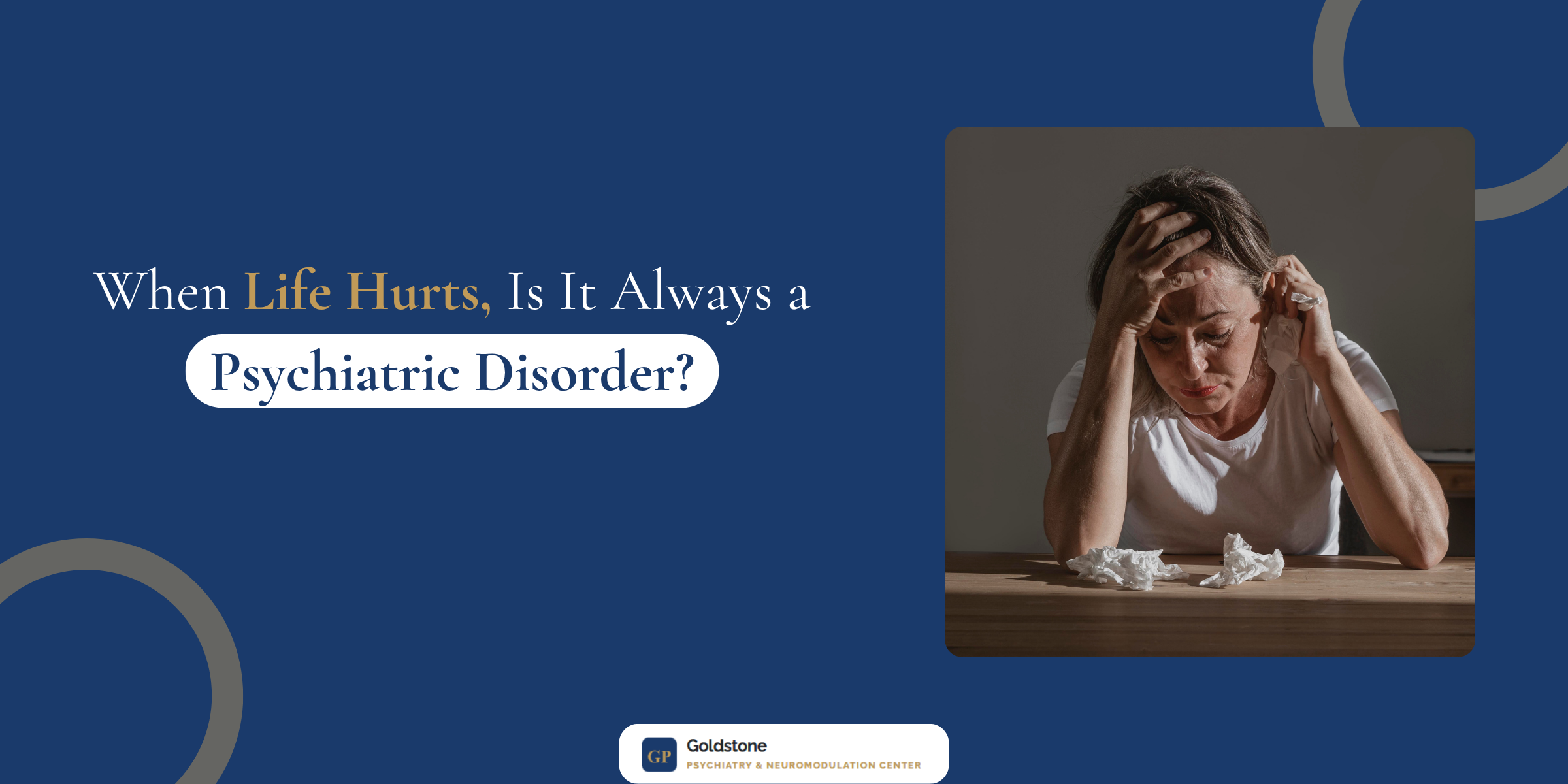
Understanding the difference between mental illness and normal human struggle
Someone can’t focus at work and starts wondering whether they have ADHD.
Someone feels their heart pound before every presentation and wonders whether it’s an anxiety disorder.
Someone goes through a breakup and tells their friends they’re depressed, and isn’t entirely sure whether they mean it casually or literally.
Someone watches a video about trauma responses at midnight and feels a jolt of recognition so strong it reorganizes how they understand their entire childhood.
Someone notices their moods swing more than other people’s and starts googling bipolar disorder.
These questions come up constantly now, and asking them is not a bad thing. Mental health awareness has genuinely helped enormous numbers of people recognize something they had been suffering with silently, sometimes for decades. People who once believed they were simply lazy, or weak, or broken in some unnameable way have found language, and then help.
But that same awareness has made a line harder to see. When mental health vocabulary becomes part of everyday conversation, it gets harder to tell where a hard human experience ends and a psychiatric disorder begins.
That question deserves a careful answer, because getting it wrong in either direction causes real harm.
Difficult feelings are part of being a person
Human beings are built to feel sadness, worry, grief, disappointment, heartbreak, frustration, loneliness, anger, and uncertainty. We are also built to lose sleep when something is wrong, and to have trouble concentrating when our lives get loud.
These experiences can hurt enormously without being illnesses.
Feeling anxious before an important exam is not an anxiety disorder. It’s what a nervous system does when something matters.
Feeling shattered after losing someone you love is not automatically major depression. It’s grief, and grief is supposed to hurt.
Struggling to concentrate during a chaotic month is not automatically ADHD. Concentration is a limited resource, and stress consumes it.
Feeling overwhelmed after something frightening happens is not automatically PTSD. Most people who go through a terrible event have a difficult period afterward and then gradually recover.
Here’s the part that matters, though, and it gets missed constantly: saying that something may be a normal human response is not the same as saying it doesn’t matter.
Pain is pain. A person going through a divorce, or caring for a dying parent, or working a job that is slowly grinding them down, is genuinely suffering. They may need support, understanding, therapy, rest, or major changes in their life. What they may not need is a diagnosis.
Needing help and having a disorder are not the same thing, and there is no shame in either one.
The opposite mistake is worse
It would be easy to read all of that and land somewhere unhelpful, concluding that psychiatric conditions are just ordinary emotions with clinical names attached.
They are not, and this matters a great deal.
Major depression is not sadness. It is a condition that can flatten a person’s ability to feel anything at all, that makes getting out of bed a genuine physical negotiation, that convinces intelligent people they are worthless in ways no argument can touch. Telling someone with major depression to think positively is like telling someone with pneumonia to breathe more deeply.
Severe anxiety is not ordinary nervousness. It is a nervous system stuck in alarm, producing physical symptoms that send people to emergency rooms convinced they’re dying.
ADHD is not laziness. It is a difference in how the brain regulates attention, motivation, and time, and people with it often work far harder than their peers to produce the same result.
PTSD is not a failure to move on. It is a memory system that has not filed something away properly, so the past keeps arriving in the present without warning.
One of the reasons the mental health conversation has grown so loudly over the past two decades is that for a very long time, people with these conditions were misunderstood, told to try harder, and left untreated for years.
So the answer is not to diagnose everything. But it is definitely not to dismiss everything either.
So how does a psychiatrist actually tell the difference?
Not, mostly, by checking whether a symptom is present. Nearly everyone has some version of nearly every symptom at some point.
The real questions are about the shape of it.
How bad is it? There’s a meaningful difference between finding it hard to focus and finding it impossible.
How long has it lasted? A rough two weeks and a rough two years are different problems.
How much of life does it touch? Does the anxiety show up only before public speaking, or does it follow the person into the grocery store, the car, and bed at three in the morning?
Is it interfering? This is often the crucial one. Is work suffering? Are relationships strained? Has the person stopped doing things they used to enjoy? Are they eating, sleeping, and taking care of themselves?
Is this different from how this person normally is? A naturally anxious person having an anxious month is different from a famously calm person who suddenly can’t stop worrying.
Has it been there since childhood, or is it new? This question does a lot of work, especially with attention problems.
Could something else be causing it? Thyroid problems. Anemia. Sleep apnea. Perimenopause. A new medication. Alcohol. Cannabis. Too much caffeine. Not enough sleep for eight months running.
Context changes everything. Two people can describe an identical symptom and be experiencing completely different things.
ADHD makes a good example
A lot of people will recognize themselves in this one.
Adult ADHD is real, common, and genuinely underdiagnosed. Many adults were never identified as children, particularly those who were bright enough to compensate, or quiet rather than disruptive, or girls, who were missed at much higher rates. These people often did fine until adult life removed the structure that had been holding them up, and then everything got harder at once.
For those patients, an accurate diagnosis can be transformative. Not because a label fixes anything, but because it finally explains a pattern they had been blaming on their character.
At the same time, trouble concentrating is one of the least specific symptoms in all of medicine. It shows up in anxiety, depression, insomnia, burnout, grief, chronic stress, substance use, thyroid disease, and the entirely ordinary experience of trying to do focused work while carrying a device engineered to interrupt you.
So relating to a video about ADHD doesn’t mean someone has ADHD. It also doesn’t mean they don’t. What it means is that they’ve noticed something real about themselves, and that noticing deserves a serious look.
A proper psychiatric evaluation asks a bigger question than “does this person have ADHD symptoms?” It asks: why is this person struggling to concentrate?
Sometimes the answer is ADHD. Sometimes it’s ADHD plus untreated anxiety. Sometimes it’s six years of bad sleep. Sometimes it’s a depression nobody has named yet. The answer determines the treatment, which is why the question is worth taking time over.
About social media and self-diagnosis
Something genuinely good has happened online. Conversations that used to be impossible are now everywhere, and people have found words for experiences they’d carried silently. Plenty of patients arrive at a psychiatrist’s office because of something they saw on a screen, and they are often right that something is going on.
The limitation isn’t that the content is wrong. Much of it is accurate. The limitation is that it can’t include the context.
“Five signs you have ADHD” can describe five real signs of ADHD. It just can’t tell you whether yours are caused by ADHD, or by the fact that you have a newborn and haven’t slept properly since March.
“Seven signs you experienced trauma” may describe you accurately without telling you whether what you need is trauma treatment, or grief support, or something else entirely.
Symptoms overlap enormously. Sorting that out requires knowing a person’s history, their timeline, their medical picture, their substances, their sleep, and how they were before all this started. A video can’t know any of that.
Self-recognition is a good beginning. It’s just a beginning rather than a conclusion.
A harder question worth sitting with
There’s a question worth asking gently, and without any accusation in it.
Modern life offers fast solutions to discomfort. We can order almost anything, distract ourselves instantly, and skip most waiting. Given that, it’s reasonable to wonder whether we sometimes expect medicine to remove feelings that are actually carrying information.
Anxiety sometimes means something matters to you enormously.
Sadness usually follows loss, and it’s doing something useful even when it’s unbearable.
Persistent dissatisfaction sometimes means a job, a relationship, or a way of living genuinely needs to change, and no medication will substitute for making that change.
Exhaustion sometimes means a person needs rest rather than a prescription.
Loneliness usually needs connection.
Chronic overwhelm often needs boundaries more than it needs anything a psychiatrist can prescribe.
And yet. Every one of those experiences can also become severe enough that treatment is exactly right. Grief can become a disorder. Stress can trigger a depressive episode in someone predisposed to one. Loneliness can deepen into something that will not lift on its own.
There’s no clean rule here, which is precisely why the evaluation matters. The useful question isn’t whether suffering qualifies for a label. It’s: what’s actually causing this, and what kind of help fits it?
Medication is sometimes exactly right, and sometimes not
Psychiatric medications change lives. For someone with significant depression, bipolar disorder, ADHD, OCD, severe anxiety, or a number of other conditions, medication can be an important part of treatment, sometimes the part that makes everything else possible.
Medication also should not be the automatic answer to every hard feeling.
Depending on what’s actually happening, the right plan might involve therapy, or better sleep, or exercise, or cutting back on alcohol or cannabis, or treating a medical problem, or changing something genuinely unsustainable about a person’s circumstances, or building skills they were never taught, or medication, or several of these at once.
Medication isn’t good or bad. It’s a tool, and the only real question is whether it’s the right tool for this particular person’s problem.
What good psychiatric care looks like
A good psychiatrist does not simply match symptoms against a list and reach for a prescription pad.
Sometimes good care sounds like: “Yes, this is depression, and treatment is likely to help significantly.”
Sometimes it sounds like: “I understand why this has been so hard, and I’m not convinced this is a psychiatric disorder. Let’s talk about what might actually help.”
Sometimes it sounds like: “There are three possibilities here and I don’t yet know which one this is. Let’s look more carefully before we treat.”
Sometimes it means recommending therapy rather than medication. Sometimes it means investigating sleep, or substances, or ordering labs. Sometimes it means naming out loud that a person’s life circumstances are the problem.
And sometimes it means prescribing, promptly and confidently, because the picture is clear.
The goal was never to give everyone a diagnosis. The goal is to understand the person in front of you well enough to know what would actually help them.
The whole picture
Mental health doesn’t come from one place, which is why one-cause explanations are almost always too small.
The body contributes: genetics, hormones, medical conditions, medications, substances, and sleep.
The mind contributes: temperament, coping style, past experiences, patterns of thinking, and what a person has already survived.
Life contributes: relationships, work, money, family, isolation, community, culture, and whether someone has a sense of purpose.
A thoughtful evaluation looks at all three. That’s why it can’t be done quickly, and why “chemical imbalance” was always too simple a story, but so is the idea that everything can be solved with better habits.
Where this leaves us
The purpose of psychiatry is not to turn every painful emotion into a diagnosis. It is also not to tell people with real illness that they need to be stronger.
Good psychiatry lives somewhere between those two failures. It takes suffering seriously, asks honestly why it’s happening, and helps a person find the kind of help that actually fits their situation.
Sometimes what someone needs is medication. Sometimes therapy. Sometimes a change in circumstances they’ve been avoiding. Sometimes time, and someone to tell them that what they’re going through is survivable. Often it’s a combination.
Your feelings can be real, important, and worth taking seriously whether or not they add up to a disorder. And if something genuinely is wrong, a careful evaluation is how you find out.
Either way, the first step is the same: understanding what’s actually happening.
Goldstone Psychiatry & Neuromodulation Center provides comprehensive psychiatric evaluations and personalized treatment for adults in Houston, Texas, with telepsychiatry available statewide. If you’ve been wondering whether what you’re experiencing warrants a professional look, that question alone is a reasonable reason to book one.
